You Walked In to Discuss It. They Walked In Already Decided.
I went on Modern CTO with Joel Beasley to talk about the extinction event coming for the CTO seat, and heard myself reverse six years of my own advice: get further into the tech.
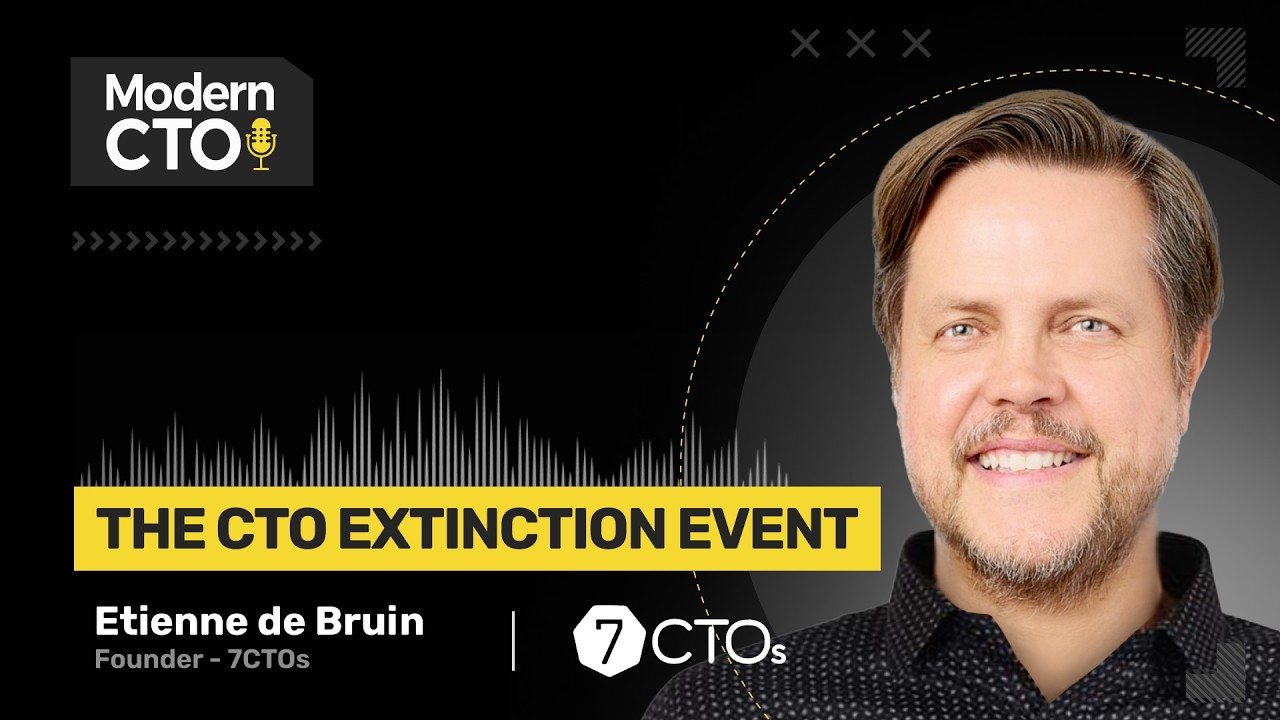
For six years my whole message to CTOs has been: get out of the weeds. Executive presence. Business objectives. Learn to read a P&L. Stop trying to win the architecture argument and start enrolling the people who control the budget.
Then I sat down with Joel Beasley on Modern CTO and heard myself reverse it.
If in the past I have been all about be less in the tech, I'm now saying you've got to be more in the tech.
The thing I got angry about
I spend a lot of my year in rooms full of CTOs. Colloquiums, forums, the hallway conversations that are usually better than the sessions. And over the last year a large share of that hallway talk has been CTOs patting each other on the back about token optimization.
Somebody cut spend by routing the cheap calls to a smaller model. Somebody has a clever caching layer. Everyone nods. Everyone gets to feel technical again.
It made me angry, and it took me a while to work out why.
Token optimization can be done with three prompts and a click. It's the part of this shift the C-suite can already see, already price, already ask for by name. If that's where your problem-solving is going, you've volunteered for a job that won't exist in three years. That's the extinction event I wrote about.
The actual frontier is sitting right there, and almost nobody else in the C-suite is willing to walk into it. What is a token, really. What is attention. What does a transformer do, and what can it structurally never do. What is a harness. What does restarting an agent mean. How does an agent know when it's done.
That last one isn't trivia. Your delivery model for the next decade depends on the answer.
One or two levels below
Years ago, back when I was writing PHP and then Rails, I asked a mentor how far down the stack I needed to go. Compiler level? Electron leaving the power plant, through the lines, into the transformer, onto my screen?
His answer stuck with me: go one or two levels below whatever you need to know to do your job.
For most of us right now, one or two levels below is the research. The papers that are hard to read because you can't get two consecutive sentences to connect. Go there. Subscribe to the Hugging Face top-papers list, take the top one or two, and be bad at reading them for a while. We've started busting them open at 7CTOs events.
Guess who else in your company is doing that.
The line I keep coming back to
My favorite thing I've written this year:
You walk in thinking that you're having a discussion. They walk in having already made the decision, looking for your buy-in.
We're no longer in a knowledge-sharing C-suite. For twenty years the technical leader's authority came from holding information nobody else at the table had. That's gone. Your CMO asked Claude what a CTO would do in this situation and got a decent answer before the meeting started.
So the job moves to enrollment. You're in that room to bring people into why option E, out of all the options, is the one worth the quarter. That's a different game from "listen to me because I know things," and it's harder, because a lot of us have had the luxury of a room full of people using words they've never heard and assuming we must be right.
Those days are over. You're being fact-checked in real time by the AI taking notes in the meeting. I write tech strategy docs now knowing they'll be fed to somebody's assistant before a human reads them, which means the thin parts of my thinking get found immediately. Useful. Also uncomfortable.
Christmas Day, SSH keys
The story I told Joel that I can't stop thinking about:
A CTO I know got a message from his CEO on Christmas Day asking for SSH keys to the production environment, because the CEO was trying to deploy something himself.
Six weeks later the whole engineering team was gone. Multi-million dollar startup. The CEO had decided he didn't need a dev team.
There is a scale at which that works for a minute. There's also a quarter coming where it turns into chaos, and I'd bet on the chaos. But that CTO never got to make the argument. He was the person who managed the team, and by December his CEO was having the more interesting conversation with a chat window.
What the model won't do for your P&L
This is the practical reason to go deeper, and it's the one that protects the business.
An executive team will cheerfully decide to throw the financials, the production rates and the invoicing into a frontier model and ask it to find the margin. It sounds wonderful at the strategy level. And the model will answer, because answering is what a generative system does. Sometimes the numbers are off by fractions. Sometimes it's invented outright, delivered with a confidence that hacks your brain.
If you can't say why that plan needs evals, or a different class of model, or plain arithmetic in an actual function, one of two things happens in the room. Your engineers don't follow you, or they follow you perfectly and quietly conclude you're a suit.
Become the rare thing
Joel had the better version of my whole article, in one sentence. He's watched automation come for a lot of teams, and the survivors are always the people who walked in on day one and said "this is interesting, show me how it works, let me help with the transition."
"The safest thing to do is become the rare thing," he said. "And the rare thing is an engaged individual who wants to push things forward."
Which is annoying, because it took me a whole article.
What I'm doing about it
My job right now is to make my engineering team unstoppable. I don't care about the 10x engineer. I want to take the most pessimistic brilliant engineer I've got and make them unstoppable, and do the same for the most junior one. I can't do that if my grasp of LLMs stops at "everyone has an API key and here's our spend versus last quarter."
So I'm starting something small called AICTO. Curated, invite-only, fly in and fly out in a day. Thirty or so people in the actual middle of AI transformation and data governance, the biggest companies in the room sitting next to the smallest ones, because everybody is hitting the same wall. First one is in Salt Lake City at the end of September. Waitlist: aicto.co/wl.
Which is funny, because I moved to Salt Lake and told everyone I wasn't here to make friends. I came for three reasons: my kids, my parents under my roof, and my mental health. Plus the snowboarding.
And then the thing I keep noticing is that the hunger to be in a room with other humans is at a thirteen-year high. We spent 2020 learning to attach an enormous cost to driving across town for a meetup. Now our colloquiums sell out months early.
When everyone can generate the answer, the scarce thing is a table of people who'll tell you your answer is wrong.
Thanks, Joel. Always therapeutic.
Refactor, the first book in my Press Any Key to Continue series, is out now on Amazon. It's about getting your autonomy back in the CTO seat: your calendar, your time, your position in the C-suite. And if you want the peer group version of all this, 7ctos.com.